
If you’ve ever been cruising down the highway in your Jeep and suddenly felt the entire front end shake violently, you already know how frightening that experience can be. It’s one of the most alarming things a Jeep owner can go through, and it’s a problem we see regularly at CAMS Automotive in Kenner, LA. Death wobble specifically affects Jeeps with a solid front axle, like the Wrangler, along with older Cherokee and Grand Cherokee models built before 2005.
Drivers with a newer Jeep vehicle may feel a similar high-speed shake, but it has a different root cause, and we’ll track that down with the same care. Either way, we want you to know exactly what’s going on under your vehicle, why it’s happening, and what it actually takes to fix it right. If you’ve been searching for a Jeep mechanic near you in Kenner, LA, keep reading.
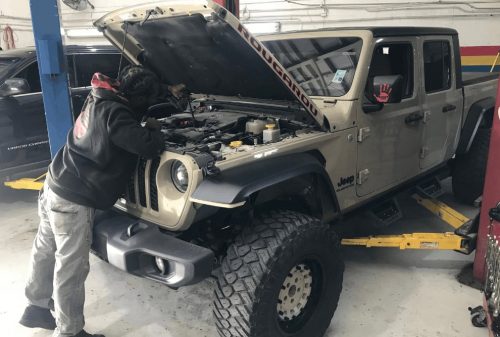
The Suspension Problem Unique to Jeep Owners
Jeep death wobble isn’t a single part failure. It’s a chain reaction. When one component in your front suspension or steering system is worn out or out of spec, it creates a vibration frequency that triggers surrounding components to oscillate violently, typically at speeds above 45 to 55 mph. One degraded part sets everything else into motion.
Most death wobble cases trace back to one or more of these parts:
- Track bar or track bar bushings: The track bar controls the lateral movement of your front axle. When it’s loose, or the bushing is worn, the axle shifts side to side, starting the wobble cycle.
- Ball joints: Ball joints connect the steering knuckle to the control arm. Worn ball joints introduce unpredictable play into your steering.
- Tie rod ends: These link your steering to the wheels. Any looseness in a tie rod end gives the wheel room to move erratically.
- Steering stabilizer: Think of this as a shock absorber for your steering. A failed one removes the buffer that keeps oscillation from becoming violent.
- Tire balance and wheel condition: An unbalanced tire or a slightly bent wheel generates a vibration frequency that can trigger everything else at highway speeds.
The frustrating reality is that death wobble rarely comes from just one bad part. Multiple components are usually degraded at the same time, especially on older Jeeps or rigs with regular off-road use.
How to Tell Death Wobble Apart from Other Vibration Issues
Not every high-speed shimmy is death wobble, but all cases of violent front-end shaking in a Jeep deserve immediate attention. Understanding the difference helps you describe what you’re experiencing when you bring your vehicle in.
Characteristics of True Death Wobble
- The shaking starts suddenly, often after hitting a small bump or road imperfection
- It’s violent and difficult to control, not a gradual vibration
- The steering wheel feels like it’s fighting you
- Slowing down below 45 mph typically stops it
- It doesn’t happen every drive, but when it does, it’s severe
Signs It's Likely a Different Problem
- A steady vibration present the entire time you’re driving (more consistent with tire balance or wheel issues)
- Shaking that worsens gradually as speed increases (often tires, wheels, or driveshaft-related)
- Vibration only when braking (typically a brake rotor issue, not suspension)
If you’re unsure which category fits your situation, the right call is to have your Jeep inspected before the problem gets worse. Call CAMS Automotive at 504-461-9838 and we’ll get your Jeep on the lift.
What a Proper Jeep Suspension Diagnosis Looks Like in Kenner, LA
At CAMS Automotive, we don’t replace parts and hope the problem goes away. When a Jeep comes in with a death wobble complaint, we inspect every front-end component before recommending anything.
Our Lift-and-Inspect Approach to Jeep Repair in Kenner
With the vehicle safely raised, our ASE-certified technicians physically test each component for play, wear, and damage:
- Track bar: We check for side-to-side movement at both mounting points and assess bushing condition visually and by hand.
- Ball joints: We use a pry bar and measurement to test for movement beyond acceptable tolerances.
- Tie rod ends: We grab the wheel at the 9 and 3 o’clock positions and feel for any looseness through the tie rod ends.
- Steering stabilizer: We check for fluid leakage and test resistance through the range of motion.
- Tires and wheels: We inspect wear patterns, look for wheel damage, and confirm balance hasn’t been lost.
We also run your Jeep through our Autel MAXISYS MS919 diagnostic tablet to scan for any electronic flags related to your steering or stability systems, especially on newer Jeeps equipped with electronic stability control. This gives us both a mechanical and electronic picture of what’s happening before any work begins.
Everything we find gets documented and explained to you in plain language. At CAMS Automotive, our motto is “We don’t sell. We educate.” You’ll always know what’s wrong and why before you approve any repair.
What Waiting Too Long Actually Costs You
Suspension problems don’t stay isolated. When one front-end component is worn, the others absorb extra stress to compensate. What starts as a single bad track bar bushing can turn into a situation where the ball joints, tie rod ends, and tires are all damaged by the time the vehicle comes in.
The Real Risk of Driving with Worn Jeep Suspension
- A loose track bar puts lateral stress on your ball joints and tie rods every mile you drive
- Worn ball joints can fail, which means loss of steering control
- Uneven tire wear caused by suspension issues shortens tire life significantly
- Ignoring one repair often means paying for three or four at the same time later
Early diagnosis is always the more affordable path. If repair costs are a concern, CAMS Automotive offers the CAMS Finance Card with a promotional period of six or 12 months with zero interest, so you can take care of your Jeep now without putting it off.
Collision Repairs and Pre-Collision System Calibration for Jeeps in Kenner, LA
Jeep death wobble isn’t the only front-end issue we handle. If your Jeep was involved in a collision, or if your pre-collision avoidance system warning light has come on, your forward-facing sensors and cameras may need recalibration.
Even a minor front-end impact can shift a sensor out of alignment. A sensor that’s off by a small degree can cause your automatic emergency braking or lane departure systems to malfunction or stop working entirely.
At CAMS Automotive, we use our Autel scanner alongside a dedicated calibration setup with a stand, lasers, and sensors to determine the exact angle your sensors are sitting at and bring them back to factory specification. Every collision repair we complete is backed by a lifetime guarantee on workmanship and parts for as long as you own the vehicle.
Why Kenner, LA Jeep Owners Trust CAMS Automotive
We’re a family-owned shop, and we run it that way. When you bring your Jeep to us, you’re not just a work order. Here’s what you can expect:
- ASE-certified technicians with hands-on experience on Jeep vehicles
- Autel MAXISYS MS919 diagnostic equipment for thorough mechanical and electronic diagnosis
- Lifetime guarantee on collision repairs for as long as you own your vehicle
- NAPA Car Care nationwide warranty covering 24 months or 24,000 miles on qualifying repairs
- CAMS Finance Card with six or 12-month zero-interest promotional periods
- Digital Vehicle Inspections during routine maintenance so you can see what our technicians found
- Transparent communication at every step, because you deserve to know what’s happening with your vehicle
We’re located at 901 Maria St, Kenner, LA 70062. Reach us at 504-461-9838.
Serving Jeep Owners Throughout Kenner and the Surrounding Area
Drivers from across the metro area trust CAMS Automotive for Jeep repair in Kenner, LA. We regularly serve families and vehicle owners from:
- Metairie, LA
- Harahan, LA
- River Ridge, LA
- Jefferson, LA
- New Orleans, LA
FAQs About Jeep Mechanic and Jeep Repair
Why is my Jeep shaking at high speeds?
High-speed shaking in a Jeep is most commonly caused by worn or loose front suspension components such as a track bar, ball joints, or tie rod ends, which can trigger a condition known as death wobble. Tire imbalance or a bent wheel can also produce vibration that worsens at certain speeds.
What causes the Jeep death wobble?
Jeep death wobble is caused by worn components in the front steering and suspension system that allow the front axle to oscillate rapidly, usually triggered by hitting a bump at highway speed. The most common culprits include a loose track bar, worn ball joints, failing tie rod ends, and a degraded steering stabilizer.
Are Jeeps expensive to repair?
Jeep repair costs vary depending on how many components need attention, the model year, and how long the issue has been developing. Catching suspension wear early is the most effective way to keep repair costs manageable.
Can I drive my Jeep if it has death wobble?
Driving with death wobble is not recommended because it makes the vehicle difficult to control and accelerates wear on surrounding suspension components. If your Jeep is shaking violently at highway speeds, have it inspected by a qualified mechanic as soon as possible.
Schedule Your Jeep Repair in Kenner, LA at CAMS Automotive Today
If your Jeep is shaking, pulling, or showing any signs of suspension trouble, don’t wait. Death wobble doesn’t resolve on its own, and every mile you put on a worn suspension system adds to the final repair bill.
CAMS Automotive is Kenner’s trusted team for Jeep repair and suspension service. Our ASE-certified technicians will inspect your vehicle thoroughly, explain exactly what they find, and give you clear, honest options before any work begins. Because we don’t sell. We educate.
Visit us at 901 Maria St, Kenner, LA 70062, call 504-461-9838, or schedule your appointment online at camsautomotive.com.
Recent Blogs:

Jeep Death Wobble in Kenner, LA: Causes, Diagnosis & Suspension Fixes
Looking for a Jeep mechanic near you? CAMS Automotive in Kenner, LA, specializes in death wobble, suspension repair, and Jeep diagnostics. Call us today.
The Collision Repair Process: What to Expect at CAMS Automotive in Kenner, LA
Learn the collision repair process in Kenner, LA with CAMS Automotive. Our proven 10-step approach restores your vehicle safely and correctly. Schedule today.
Do You Always Need to Replace Brake Pads and Rotors Together in Kenner?
Brake pad and rotor replacement in Kenner, LA. Restore braking power with trusted service at CAMS Automotive. Book your brake repair appointment today!