Published November 18, 2025. Updated with expanded local ADAS calibration guidance for Kenner drivers.
If you’re searching for “ADAS calibration near me” after a collision in Kenner, LA, you need to know something most body shops won’t tell you: even a minor fender bender can knock your vehicle’s safety sensors out of alignment. ADAS calibration after a collision restores the precision your cameras, radar, and sensors need to protect you on the road. Without it, your automatic emergency braking, lane departure warning, and blind spot monitoring could give you false readings or fail completely.
At CAMS Automotive, we use professional-grade automotive calibration services and diagnostic equipment to ensure every sensor is working exactly as the manufacturer intended. Here’s what every driver in the Kenner and Greater New Orleans area should understand about ADAS technology, why collisions compromise it, and what proper recalibration looks like.
What Is ADAS and Why Should You Care?
Advanced Driver Assistance Systems are the technology features in your vehicle designed to prevent accidents and keep you safe. If you drive a newer Honda Civic, Ford F-150, Nissan Altima, or any modern vehicle, you likely have several ADAS features working behind the scenes every time you drive.
Common ADAS Features in Your Vehicle
- Automatic Emergency Braking: Stops your car when it detects an imminent collision
- Lane Departure Warning: Alerts you when you drift out of your lane
- Adaptive Cruise Control: Maintains a safe distance from the vehicle ahead
- Blind Spot Monitoring: Warns you of vehicles in adjacent lanes
- Forward Collision Warning: Gives you advance notice of potential impacts
All these features depend on cameras, radar sensors, and other components mounted throughout your vehicle. Most commonly, you’ll find cameras behind the windshield, radar sensors in the front and rear bumpers, and ultrasonic sensors along the sides of your car.
The Physics of Sensor Alignment and Why Millimeters Matter
Here’s something we always explain to our customers: this really comes down to basic physics. That camera behind your windshield is projecting a cone of vision down the road. At 60 mph, you’re covering 88 feet every single second. If that camera is off by just one degree, it’s already missing the target by more than five feet at 300 feet out. In real terms, that’s the difference between your car seeing a stopped vehicle in your lane and not seeing it at all.
How Radar and Camera Angles Work in Kenner Driving Conditions
Radar sensors emit radio waves in a focused beam pattern. When a collision shifts the sensor housing even slightly, that beam pattern tilts. Instead of scanning the lane directly ahead of you on Veterans Memorial Boulevard or I-10, the radar might be aimed at the guardrail or the lane next to you. The sensor still functions. It still sends data. But the data it sends to your vehicle’s computer is wrong.
Cameras work similarly. Your lane departure system reads painted lane markings and calculates your vehicle’s position between them. A camera shifted by two degrees interprets your centered position as a drift. You’ll get constant false warnings, or worse, you’ll start ignoring real ones.
This is why automotive calibration services require manufacturer-specific procedures, precision targets, and controlled environments. There’s no margin for “close enough” when physics is working against you at highway speeds.
The Millimeter Problem: How Collisions Affect Precision Systems
Here’s the issue most drivers don’t understand. ADAS sensors require precision alignment down to the millimeter. During a collision, even a gentle bump can shift these components just slightly out of position. You can’t see it with the naked eye, but your safety systems definitely feel the difference.
What Happens During Impact
- Front-End Collisions: Radar sensors in the bumper shift angle, forward-facing camera moves behind the windshield, and hood deformation affects sensor positioning.
- Rear-End Impacts: Backup camera alignment changes, rear radar sensors for blind spot monitoring shift, and cross-traffic alert sensors become misaligned.
- Side Collisions: Door-mounted sensors move out of position, side-view mirror cameras require recalibration, and blind spot detection zones become inaccurate.
Think about it like this: your forward-facing camera needs to point straight ahead down the centerline of your vehicle. If a collision shifts that camera just two degrees to the left, your lane departure system now thinks you’re always drifting right.
The Silent Safety Risk Kenner Drivers Are Taking
Skipping ADAS sensor repairs after your collision might seem fine at first. Your dashboard looks normal, no warning lights are flashing, and your car feels like it’s running perfectly. But here’s the reality: your safety systems aren’t protecting you the way they should.
Real-World Consequences of Skipped Calibration
- Automatic Emergency Braking Failures: The system doesn’t detect obstacles correctly and fails to stop your vehicle in time.
- False Lane Departure Alerts: Constant beeping and warnings for lanes you’re not leaving, causing you to ignore real alerts.
- Blind Spot Monitoring Errors: Missing vehicles in adjacent lanes or detecting phantom vehicles that aren’t there.
- Adaptive Cruise Control Issues: Following too closely or maintaining incorrect distances from vehicles ahead.
A miscalibrated system creates unpredictable behavior that drivers aren’t prepared for. If you’ve recently had collision work done and you’re experiencing any unusual behavior from your safety features, call us at 504-461-9838 to schedule an ADAS calibration diagnostic.
Why Most Body Shops in Kenner Can't Handle ADAS Calibration
Collision repair with ADAS calibration demands very specific tools and training that most shops simply don’t have.
Equipment Requirements for Proper Automotive Calibration Services
- Diagnostic Tools: Advanced scan tools like the Autel MAXISYS MS919 that can communicate with vehicle computers and run manufacturer-specific calibration procedures.
- Calibration Targets: Precision-printed patterns that cameras and sensors must recognize at exact distances.
- Laser Alignment Systems: Equipment that ensures targets are positioned within millimeter-level accuracy.
- Manufacturer Software: Up-to-date calibration procedures for every make and model, which change constantly.
This isn’t something you can do with a code reader from the auto parts store. Each manufacturer has different calibration requirements. A system in your F-150 calibrates differently from one in your Altima. A 2020 model year might have different procedures than a 2023.
Static vs. Dynamic: Two Types of ADAS Calibration Explained
Not all automotive calibration services follow the same process. Depending on your vehicle’s make, model, and the specific ADAS components involved, your car may need one of two calibration methods, or sometimes both. Understanding the difference helps you know what to expect when you bring your vehicle in for service in Kenner.
Static Calibration (In-Shop Process)
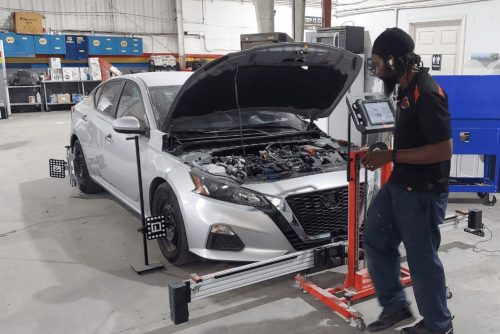
This happens in a controlled shop environment. We position your vehicle on a level surface, set up our calibration equipment at precise distances and heights, and run the manufacturer’s calibration procedure using diagnostic equipment. This method works for most camera-based systems and many radar sensors. Typical duration is 1-2 hours.
Dynamic Calibration (On-Road Process)
This requires driving your vehicle under specific conditions while the system learns and adjusts itself. We follow predetermined routes at set speeds, making specific maneuvers that allow the ADAS components to recalibrate themselves based on real-world data. Typical duration is 30 minutes to 1 hour.
Some vehicles need only static calibration. Others require only dynamic. Many newer vehicles demand both to ensure complete accuracy.
When You Need ADAS Calibration
Here’s a breakdown of situations that require professional ADAS recalibration:
| Situation | Why Calibration Is Needed | Risk Level |
|---|---|---|
| Front/rear bumper replacement | Radar sensors are removed and reinstalled | High |
| Windshield replacement | Forward camera position changes | High |
| Any collision damage | Impact shifts sensor positions even slightly | High |
| Wheel alignment service | Changes the vehicle geometry, affecting sensor angles | Medium |
| Suspension repairs | Alters ride height and sensor positioning | Medium |
| Side mirror replacement | Affects blind spot camera alignment | Medium |
A common misconception is that only major accidents require ADAS recalibration. Some of the most critical calibration needs come from seemingly minor incidents. You back into a parking barrier at low speed and barely scratch your rear bumper. But that bumper houses radar sensors for your blind spot monitoring and rear cross-traffic alert. Even without visible damage, that impact can shift the sensor angle just enough to compromise its accuracy.
How CAMS Automotive Handles ADAS Calibration in Kenner, LA
At CAMS Automotive, we don’t just fix the damage you can see. We ensure every safety system functions exactly as it should.
Our ADAS Calibration Process
- Complete Diagnostic Scan: We use our Autel MAXISYS MS919 diagnostic tablet to identify which systems need calibration.
- Pre-Collision System Setup: Our calibration stand uses lasers and sensors to determine the exact angle of your ADAS components.
- Precision Target Placement: We position calibration targets at manufacturer-specified distances, verified with laser measuring equipment.
- System Recalibration: We run the specific calibration procedures for your vehicle’s make, model, and year.
- Verification Testing: We confirm all systems are functioning correctly before returning your vehicle.
Whether you drive a CR-V, Sierra, Tucson, or Grand Cherokee, our team has the training and equipment to calibrate your ADAS sensors correctly. Visit us at 901 Maria St, Kenner, LA 70062, or call 504-461-9838 to schedule an ADAS calibration appointment. You can also learn more about our ADAS calibration services in Kenner and our full collision repair offerings.
Why Choose CAMS Automotive for ADAS Calibration
We know you have choices when it comes to collision repair and calibration in the Kenner and Greater New Orleans area. But at CAMS Automotive, we believe in our motto: “We don’t sell. We educate.” When you bring your vehicle to our shop, we take the time to explain exactly what’s going on and what needs to happen to get your safety systems back to factory specifications. We treat every customer like family, and we know how important it is to keep the whole family fleet safe on the road.
- ASE-Certified Technicians: Our team understands both the mechanical and electronic sides of modern vehicles, ensuring your ADAS calibration is done right the first time.
- Autel MAXISYS MS919 Diagnostic Tablet: We use advanced scanning technology to communicate directly with your vehicle’s computer systems and run manufacturer-specific calibration procedures.
- Pre-Collision Avoidance Calibration Setup: Our dedicated calibration stand with lasers and sensors verifies the exact positioning of every ADAS component on your vehicle.
- Lifetime Collision Repair Guarantee: For as long as you own your vehicle, we guarantee the quality of our repair against any defects in workmanship or parts.
- NAPA Car Care Nationwide Warranty: Your repairs are backed by a 24-month, 24,000-mile warranty that’s honored at NAPA Car Care centers across the country.
- CAMS Finance Card: Need help covering the cost? Our financing option offers promotional periods of six or 12 months with zero interest.
FAQs About ADAS Calibration After a Collision
What is ADAS calibration?
ADAS calibration is the process of precisely realigning and reprogramming your vehicle’s safety sensors, cameras, and radar to meet manufacturer specifications. It ensures features like automatic emergency braking, lane departure warning, and blind spot monitoring function accurately. This process requires specialized equipment and software specific to your vehicle’s make and model year.
Do I need an ADAS calibration after a bumper replacement?
Yes, you almost always need ADAS calibration after a bumper replacement because radar sensors are typically mounted inside the front and rear bumpers. Removing and reinstalling the bumper, even carefully, can shift sensor positioning enough to affect accuracy. A professional calibration confirms everything is aligned correctly before you drive.
Who does ADAS calibration near me?
ADAS calibration is performed by collision repair and automotive service shops that have invested in specialized diagnostic scanners, calibration targets, and laser alignment systems. Not every body shop has this equipment, so it’s important to ask whether a shop has manufacturer-specific calibration capabilities before scheduling your repair.
How long does ADAS calibration take after a collision?
ADAS calibration typically takes two to four hours, depending on whether your vehicle requires static calibration, dynamic calibration, or both. The process cannot be rushed because precision alignment of sensors and cameras is essential for your safety on the road.
Do all collision repair shops in Kenner offer ADAS calibration?
No, many collision repair shops lack the specialized equipment and training required for proper ADAS calibration. CAMS Automotive has invested in the Autel MAXISYS MS919 diagnostic tablet and complete calibration setup necessary to service modern vehicles correctly, setting us apart from shops that only handle cosmetic repairs.
Professional ADAS Calibration After Collision in Kenner, LA at CAMS Automotive
Your life might depend on sensors that are off by just a few millimeters. If your vehicle has been in any collision, those advanced safety systems need precision recalibration by technicians who understand the technology and the stakes. CAMS Automotive uses professional-grade diagnostic equipment and laser-guided calibration tools to ensure every sensor and camera works perfectly. Our ASE-certified technicians perform responsible collision work backed by a lifetime guarantee. Don’t settle for repairs that only look good. Get repairs that keep you safe.
Find us at 901 Maria St, Kenner, LA 70062, call 504-461-9838, or request an appointment online and experience truly complete collision repair.
Recent Blogs:

Jeep Death Wobble in Kenner, LA: Causes, Diagnosis & Suspension Fixes
Looking for a Jeep mechanic near you? CAMS Automotive in Kenner, LA, specializes in death wobble, suspension repair, and Jeep diagnostics. Call us today.
The Collision Repair Process: What to Expect at CAMS Automotive in Kenner, LA
Learn the collision repair process in Kenner, LA with CAMS Automotive. Our proven 10-step approach restores your vehicle safely and correctly. Schedule today.
Do You Always Need to Replace Brake Pads and Rotors Together in Kenner?
Brake pad and rotor replacement in Kenner, LA. Restore braking power with trusted service at CAMS Automotive. Book your brake repair appointment today!